Ancient Mediterranean Routes: Corridors of Trade, Economy and Interaction Through the Ages
Course Description
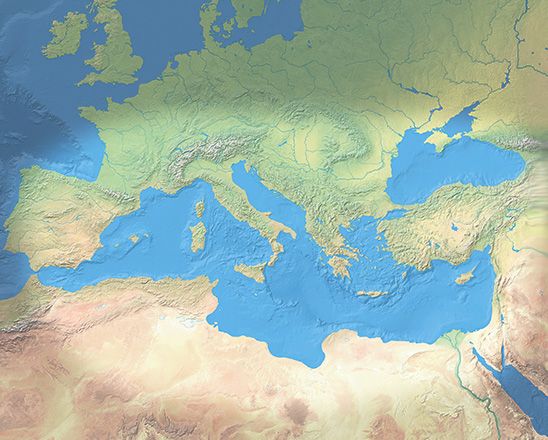
The Mediterranean Sea (also known as the Middle or Great or White Sea) is more of a bridge rather than a barrier between cultures. Sailors and merchants were (and still are) crossing this magnificent space, the world’s largest inland sea, for thousands of years. Ports-of-trade, maritime networks and caravan routes allowed the movement of raw materials and finished products, as well as of people, ideas, technologies, religious beliefs, viruses and cures. This course explores the dynamics of mobility, trade and exchange networks in the Mediterranean from prehistory (3rd mil. BCE) to Late Antiquity (ca. 7th C. CE). These dynamics have shaped economic and military superpowers, all thriving and eventually collapsing, sometimes overlapping in this quite unique region.
Through a series of case studies, course participants will discuss the evolution of maritime technologies, economic systems, values and prices, distribution of ideas, aspects of warfare and piracy as observed in the practices of different peoples, such as the Egyptians, Phoenicians, Greeks, Etruscans, Romans, Carthaginians and Iberians. Textual sources, data from material culture, interdisciplinary studies on environment and technology, as well as personal observation through museum and site visits will be the necessary tools for understanding this region from a Pan-Mediterranean perspective. This is an area of constant transformation exactly because of the human mobility: lemon and orange trees came from the Far East through the Arabs; tomatoes from Peru; Cypress trees from Persia. The Mediterranean, “Our Sea” for the Romans, offers a unique arena to study human interactions, political and economic histories, and the trajectories of social change
Aims
• To provide an advanced knowledge of the prehistory and early history of the societies and cultures in and around the Mediterranean.
• To instill an interdisciplinary and wide-ranging approach towards the study and understanding of ancient economies and trade networks.
• To promote personal research and to stimulate students to work beyond the borders of their chosen academic fields.
• To appreciate the various regional methodological approaches and limitations.
Learning Outcomes
At the end of the course, students will have
• Studied the geography and chronology of the Mediterranean region from prehistory to Late Antiquity.
• Explored how economy and exchange shaped cultural and social traits as well as practices.
• Discussed the constant changes of major political players (kingdoms, states and empires)
• Surveyed all the major ancient cultures and civilizations in the region.