Civilizations in Contact: The Aegean World and Its Neighbors (Athens, Santorini, Crete, Nafplion)
This course provides an interpretative survey and a thematic coverage of the prehistory of the Aegean and the Eastern Mediterranean cultures with a special focus on the Late Bronze Age (ca. 1700-1050 BCE). The students will explore this brilliant moment in the history of Greece, the Aegean Bronze Age, within the geographical context of the Eastern Mediterranean littoral, paying special attention to Egypt. A number of aspects of everyday life will be explored, such as architecture and planning, burial practices, trade and exchange, scripts and literacy, religion and ritual, arts and crafts, hierarchy and political organization in order to appreciate the various layers of social life.
The aim of the course is to illustrate the relationship between prehistoric Greece and the neighboring regions, while exploring the archaeological sites and material culture of the Aegean societies. The course aims also at making students reflect on a number of major research questions and methodological approaches: What was the role of Egypt in affecting Minoan art and culture? How did Crete influence Mycenae? Were the island harbour-towns major players in the trade networks? These questions will be discussed from an eastern Mediterranean perspective with references to the other important “players” in the political and economic arena.
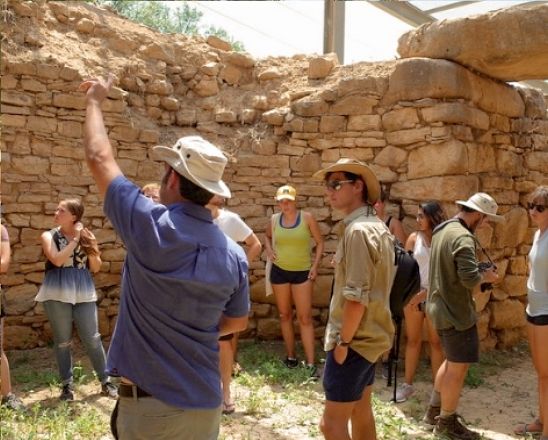
The participants will benefit through personal autopsy from accessing the unique collections of Egyptian and Aegean prehistoric antiquities at the Athens National Archaeological Museum and the stimulating collection of Cypriot antiquities at the Museum of Cycladic Art, as the course will start in Athens. A great part of the course will take place outdoors: the site of Akrotiri on Thera (Santorini), before moving to the island of Crete, a land of extreme archaeological importance. There they will explore to explore the magnificent sites of Knossos, Malia with Quartier Mu and Phaistos, the villa of Nirou Khani and the Archaeological Museum of Heraklion, as well as cemetery of Phourni and the craftspeoples’ town of Gournia. As it is crucial to study these cultures in depth, they will be discussed within their greater Aegean social and political context. Thus a three-day excursion to the Peloponnese will be a fundamental part of this summer course. Students will visit the citadels of Mycenae, Tiryns and Midea, the cemetery of Dendra and the settlement of Lerna, as well as the Archaeological Museum of Nauplion. This great journey will conclude in Athens where the great mosaic of Eastern Mediterranean cultures will be appreciated with references to Cyprus, Hittite Anatolia and the vassal states of the Levant.
Enrollment
This course requires a minimum enrollment of 10, with a maximum enrollment of 20.
Credit
60 contact hours
Essential Information
The course starts and ends in Athens. Transportation between Athens and the rest of the course’s destinations, as well as during day excursions is included in the course fee. Enrolled students will have access to detailed information prior to departure that will include directions to the Academic Center and other practical information about residing in Athens. CYA recommends the following website for general information about Athens and Greece: http://www.athensguide.com/.
IMPORTANT NOTE: This course involves extensive travel. Be wary of overpacking. Pack only what you can carry comfortably, because you will be required to check- in and out of accommodations for each stay/travel segment of this course. It will also be useful to bring with you travel-size cosmetics.
Housing
While in Athens, students are housed within walking distance of the CYA Academic Center in either CYA student apartments located in the Pangrati neighborhood of central Athens or in hotel accommodations arranged by CYA. CYA apartments are simply furnished and equipped with a full kitchen and air-conditioned bedrooms; towels, linens and housekeeping service will be provided. Hotel accommodations will be in simple 2- or 3-star hotels, double- or triple-occupancy, with air-conditioned rooms.
Facilities
The CYA Academic Center is located next to the Athens Marble Stadium and houses classrooms, the library, the student lounge and cafeteria, computer facilities (including wireless access for those students who choose to bring laptop computers), laundry facilities, and administrative offices. The Academic Center is accessible Monday-Thursday 9:00 a.m.-7:00 p.m., Friday 9:00 a.m.-6:00 p.m.
Meals
When class is in Athens a full mid-day meal will be served weekdays in the CYA cafeteria between the hours of 12:00-3:00 p.m. During study travel, breakfast will be offered at the Hotels. A welcome dinner and a farewell lunch are also included in the course fee.
Day-to-Day Program & Itinerary
The day-to-day program and itinerary of the course are subject to change. Students are advised not to make plans for their free time or weekends in advance, as class schedules and site visits may be re-scheduled depending on local conditions.