History, Power, and Conflict in the Eastern Mediterranean
Course Description
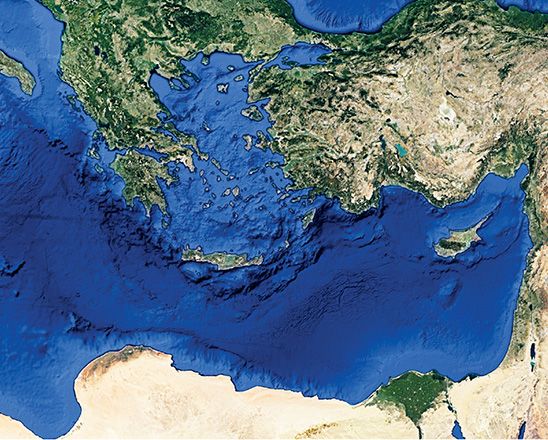
The Eastern Mediterranean has always been one of the most important meeting points of humanity, from the Bronze Age civilizations that flourished along its coasts to today’s trade corridors and energy pipelines that traverse the Eurasian landmass. However, it is a region that has also been defined by conflict and competition. Today, the Eastern Mediterranean continues to be a global flashpoint, a border between the Global South and the Global North along which the Great Powers continue to clash.
The course will give students the opportunity to learn about this strategically critical area, its current challenges and future opportunities. Students will thus reflect on the future of regional interconnectivity, the importance of non-state actors, and the importance of the Eastern Mediterranean’s energy deposits. To complement this, students will also study the key actors present in the region (including the European Union, Turkey, the Arab states of West Asia and North Africa, as well as the United States, Russia, and China).
The region’s complex interrelations continue to be largely defined by its past. To understand the Eastern Mediterranean today and its future, it is important to be aware of its recent past. The course will therefore delve into the region’s 20th century history to illustrate how the status quo was shaped by two World Wars, decolonization, and the Cold War.
Course Approach
The course will be broken down into three core thematic units:
1) The Historical Context of the Eastern Mediterranean
2) Regional and global actors: Europe, Turkey, the Arab states, and the Great Powers
3) Key themes: Challenges and Opportunities
As many of the questions touched upon over the duration of the course continue to develop daily, it would be beneficial for students to approach this course in a spherical manner. Remaining up to date on the important news or pursuing avenues of interest from the material covered will allow students to deepen their understanding of the region as a whole and will help contextualize knowledge gained from the class as their independent reading and study will offer them the opportunity to apply it to pressing questions of security, diplomacy, social justice, and economic prosperity.
Class discussions and debates will be key parts of the course that will allow students to understand, interpret, and express their views on issues. However, it is important to stress that all three units directly relate to the daily experience of the millions who call the Eastern Mediterranean home. Respect of differing views and opinions, as well as a level of sensitivity to these contentious issues, is paramount.
To this end, students can also expect to further develop their ability to critically approach available sources, evaluating the available material for biases or agendas.
Learning Objectives
By the end of the course, students will be able to:
1) Reflect on the re-emergence of the importance of the Eastern Mediterranean in the 20th century and the key events that shaped it.
2) Recognize how the history of the region continues to reverberate in contemporary challenges.
3) Analyze the complex relationships between the key actors and the impact of interdependence in the region.
4) Identify the main challenges facing the region today and discuss and evaluate how they affect the broader area.
5) Apply their knowledge and understanding to examine possible future opportunities.